


 MENU

HAWK THINKS INDIAN. Dan Hawk (Menominee), a student at College of Menominee Nation is part of a campaign telling how tribal colleges and American Indian students are using their intellectual capital - traditional solutions - to solve modern-day problems. Photo courtesy of American Indian College Fund
For 20 years, the American Indian College Fund (the Fund) has been helping students like Dody Begay (Diné) to afford a higher education. Begay is studying applied computer technology at Navajo Technical College in Crownpoint, NM. He says receiving a scholarship from the Fund meant that financial pressures did not force him to give up on his dream of being a computer animator.
Begay was raised in the traditional way with his nine family members alongside many adopted brothers and sisters. It wasn’t easy growing up traditionally, and he credits his mother for keeping his family together through her teachings and stories while she was weaving.
Begay was badgered and bullied by others who were involved with gangs, drugs, and alcohol. After his father died when he was 13, Begay took a job at a local Taco Bell to help with the family’s expenses.

Coming from a family with limited financial means, Begay’s scholarship from the American Indian College Fund helped him get one step closer to his goal of earning a master’s degree in Applied Computer Technology and Animation with a minor in Information Technology. An outstanding student and member of the student senate, Begay also earned Navajo Technical College’s Student of the Year award for 2007-08.
The first tribal college was established on the Navajo Reservation by the Navajo Nation in 1968 during the Civil Rights movement. The Navajo recognized the need to educate future generations but wanted to do so in a way that celebrated and preserved their own unique culture and language.
Today the tribal colleges and universities (TCUs) educate American Indian students across the country and provide much-needed services to Native communities. In addition to providing more than 4,000 scholarships for American Indian students last year, the American Indian College Fund also provides tribal colleges with funding and programmatic support.
The American Indian College Fund was created in 1989 by the tribal colleges and universities and private partners to raise funds for scholarships to help students like Begay and for the colleges themselves. The TCUs hired Barbara Bratone, who had worked in development for more than 16 years, as the founding executive director. She helped them establish the board, policies, and relationships with funders. The Fund was initially located in New York City until it moved to Denver in 1995.
In 1997, the board hired Richard B. Williams (Oglala Lakota/Northern Cheyenne) to head the Fund. Williams, who is now the president and CEO of the Fund, has been a lifelong advocate of education.
Williams was encouraged by his grandmother to attend college as a young boy, when she told him she was saving silver dollars for his tuition. He fulfilled his grandmother’s dream at the University of Nebraska, where he became the first American Indian student to graduate with a Bachelor’s of Arts (Magna Cum Laude). In 1999 the University of Nebraska honored him with the Alumni Achievement Award and Distinguished Alumni Award. He also earned an M.A. in Education Administration (Summa Cum Laude) from the University of Wyoming in 1987. In 2007 he was awarded a Doctor of Humane Letters, honoris causa, from Roger Williams University in Bristol, RI.
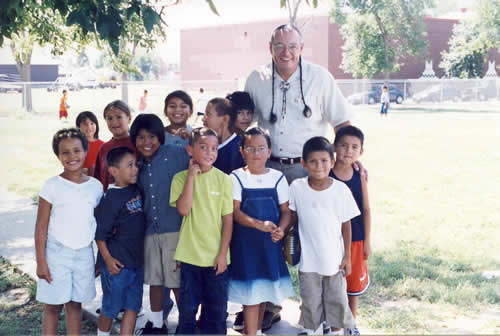
PASSIONATE ABOUT EDUCATION. Richard B. Williams, President and CEO of the American Indian College Fund, with students at the Theodore Jamerson Elementary School which is located on the campus of United Tribes Technical College in Bismarck, ND. Photo courtesy of the American Indian College Fund
A teacher and historian, Williams brings his passion for educating people about American Indian issues to the Fund. One of his special passions is Native language immersion programs; he is studying Lakota to meet his goal of becoming a fluent speaker.
Throughout his education career, Williams has noticed that Native people have tremendous intellectual capital but often are not aware of it. A personal dream came true for Williams when the Fund received an historic $17.5 million, five-year grant from Lilly Endowment Inc. to build the intellectual capital of tribal colleges.
Named Woksape Oyate (Lakota for Wisdom of the People), the initiative, now in its second year, allows the diverse tribal colleges to tailor programs to address their individual needs while strengthening the entire tribal college system by enhancing recruitment, retention, and development of highly qualified tribal college faculty, staff, and students. The program is also increasing leadership development programs, fellowship and sabbatical opportunities for staff, and pipeline programs to bring the best and brightest students back to teach at their tribal colleges.
Woksape Oyate is strengthening academics by helping tribal colleges develop honors programs for students and encouraging exchange programs to attract internationally-renowned instructors to tribal college campuses. It is also providing professional development opportunities for tribal college faculty and creating tribal college academic centers of excellence in reservation communities.
The program at Sitting Bull College in Fort Yates, ND, is one example. The school has opened a state-of-the-art entrepreneurial center to serve both the campus and the community. The entrepreneurial center will train people how to start, run, and succeed in their own businesses, bringing economic development and jobs to the reservation.
As part of its 20th anniversary celebration, the Fund, along with the award-winning advertising agency Wieden+Kennedy, is rolling out its new public service announcement campaign, titled THINK INDIAN. The campaign tells how tribal colleges and American Indian students are using their intellectual capital – traditional solutions – to solve modern-day problems.
To create the campaign, the American Indian College Fund and Wieden+Kennedy documented the stories of American Indian students studying at tribal colleges for a series of advertisements. The advertisements include Native students on-location at the College of Menominee Nation in Keshena, WI; Sitting Bull College; United Tribes Technical College in Bismarck, ND; and the Institute of American Indian Arts in Santa Fe, NM. Students were selected to participate in the campaign based on their scholarship status, academic performance, dedication to preserving and passing on traditional Native values, and their incorporation of traditional cultural mores with modern education and technology into their planned career paths.
The advertisements promote how the tribal colleges and universities preserve the uniquely American Indian way of thinking while fusing new ideas with old ways. Williams says, “They reflect how American Indian cultural knowledge is being preserved by tribal colleges and used to solve modern-day problems for all people. They also depict the depth, beauty, and tenacity inherent in the American Indian students and community that we serve.”
The advertisements are being placed in national publications, including The New York Times Magazine, Harper’s, O Magazine, and more. Advertisements are designed to induce individuals to give generously for scholarships. In addition to individual donors, the Fund also receives gifts from corporations and private and corporate foundations.
Twenty years ago in 1989, the Fund raised $29,900 for the colleges. By the 2007-2008 year, that amount had increased by more than 100 fold to $3.7 million.
“The American Indian College Fund is the leading provider of scholarships to American Indian people,” Williams says. “By providing the means to get an education with the help of our loyal donors, we provide Native people hope for a better future. In these economic times hope is more important than ever to American Indians, who have historically been the poorest Americans and continue to be so.”
Dan Hawk (Menominee), a student at the College of Menominee Nation who is featured in the Fund’s ad campaign, says, “Good things come in small (tribal college) packages. We can start the path of education at our tribal doorstep and then take our values and beliefs to other places where others can see who we really are. In the case of the Menominee, we can take sustainable development that our elders taught us and teach the rest of the world what our elders knew.”
Dina Horwedel has more than 15 years of experience in nonprofits. She has a B.S. cum laude in journalism from Bowling Green State University and a juris doctorate degree from Cleveland Marshall College of Law. She has lived and worked in Europe, Central Asia, and Africa. Horwedel is a licensed attorney in Colorado. She has served as the director of public education for the American Indian College Fund since 2007.
To see Richard Williams’ articles about Native intellectual capital, see TCJ Vol. 14, No. 2; Vol. 15, No. 1; and Vol. 17, No. 4.


Leave a Reply
You must be logged in to post a comment.