


 MENU
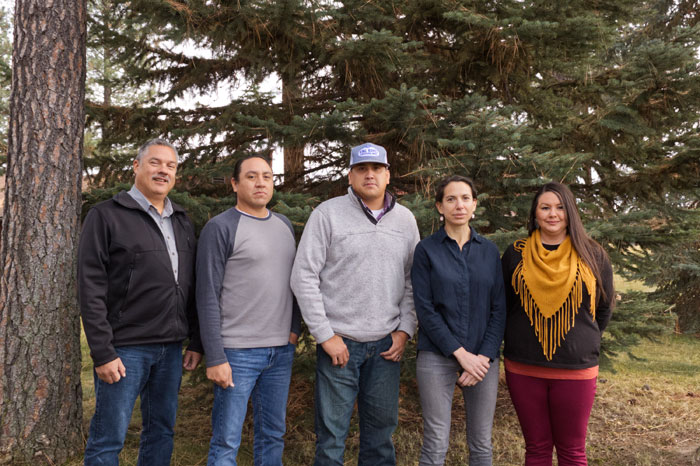
Salish Kootenai College (SKC) has established the Indigenous research Center (IRC), which seeks to diversify scientific thought and advocates that an Indigenous experience and approach to science is novel and innovative. The IRC strives to realize diversity through a science system that is distinctly Indigenous while also legitimizing the system within an Indigenous validation structure.
The center was proposed and funded through the NSF’s Tribal Colleges and Universities Enterprise Advancement Centers, which aims to create collaborative STEM-education research experts to support and promote tribal colleges’ STEM goals, needs, and aspirations as well as the interests of their respective chartering tribe(s).
The idea for the IRC began in 2013, when SKC faculty from life science, hydrology, biology, psychology, Native American studies, environmental science, and forestry formed a group to investigate the concept of Indigenous research methodologies. This multidisciplinary team worked toward deepening an understanding and use of Indigenous research methodologies by engaging in personal and directed study, and through the development of new research courses at SKC. The faculty group met weekly to discuss research studies, evolving research perspectives, a vision for research at SKC, and individual research-related aspirations.

From 2014 to 2016, SKC researchers Dr. Regina Sievert and Cecillia Arnoux conducted a study on the value of establishing an Indigenous research center at SKC. The study consisted of a needs assessment conducted with potential tribal college and tribal community partners along with a self-study of SKC to determine its readiness to support a research center.
The study provided the foundation to initiate the IRC. From 2017 to 2018, a team of SKC faculty, including Dr. Shandin Pete (Seliš/Diné) from the SKC Hydrology Department; Salisha Old Bull (Seliš/ Apsáalooke), formerly of the Governance and Tribal Administration Program; Aaron Brien (Apsáalooke) of the Tribal Historic Preservation Program; and Dr. Serra Hoagland (Kawaika) of the SKC TrEES Program, wrote the proposal for the IRC. Dr. Steve Dupuis was named the new center’s administrator, while Shandin Pete was appointed director and Aaron Brien, Kamiah Dumontier, and Dr. Serra Hoagland as core leaders.
The IRC will advance an understanding and establish the importance of an Indigenous worldview for STEM research while coalescing a research structure from within the tribal community. The mission of the center is to realize an Indigenous research methodological framework built by multiple scholars with community perspectives for the betterment of tribal, local, and national understandings of science. The IRC will engage American Indian faculty, students, and community members in a collaborative environment and will utilize Indigenous research methodologies to produce new knowledge for the perpetuation and prosperity of the tribal college and its local community.
The center will invite American Indian faculty and tribal community members with cultural and STEM knowledge to SKC for focused study, research, instruction, and dialogue that advances Indigenous research methodologies. Additionally, a focused colloquium will bring local, regional, and international researchers to campus to discuss the current state of knowledge using such methodologies. The colloquium will also sponsor student research while encouraging community dialogue and discourse on Indigenous knowledge.
The IRC will also advance the use and awareness of findings that employed Indigenous research methodologies. The center will support selected STEM research by SKC or visiting scholars as well as undergraduates that utilizes Indigenous methodologies. Additionally, the center will develop and provide courses and workshops that foster student and faculty understanding of agendas, perspectives, and methods for conducting culturally important and appropriate research with and by Indigenous peoples. The IRC will convene an annual symposium that focuses on Indigenous research methodologies in STEM.
Finally, the IRC will build institutional capacity for the advancement of Indigenous research methodologies. To achieve this objective, the center will develop an appropriate training module that provides researchers with a broad understanding of special concerns when working in Native communities. The IRC will house a library of documents and archival materials related to Indigenous worldviews and research. The history of Western depreciation of Indigenous knowledge through a façade of diversity in science and the museumization of Indigenous worldviews has caused a rift between these two ways of understanding. However, we can move toward resolution through a concerted effort to validate a paradigm constructed from an Indigenous perspective that clearly communicates with other cultures and worldviews.
The center seeks to do just that through education and outreach. research grounded in Indigenous worldviews by Indigenous researchers with Western science training and deep Indigenous cultural understandings will contribute to defining important processes, pathways, and knowledge production. Concomitantly, this will aid in answering questions from the Western and Indigenous scientific communities concerning the “what, why, how, and for whom” the research is being conducted. Seeking these answers will allow for a typology of research that advances a union between Indigenous and Western knowledge.


Leave a Reply
You must be logged in to post a comment.