


 MENU
MENU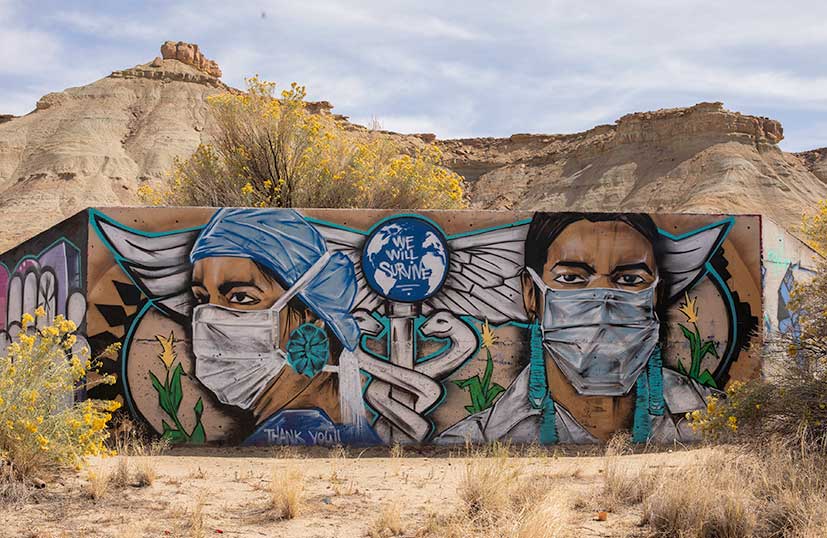
We Will Survive by Ivan Lee (Navajo). Photo by Kayla Jackson of Diné College
In 1781, in what is today Montana, a group of Piegan Blackfeet scouts came across an out-of-place Shoshoni encampment. The discovery immediately raised alarms as the two tribes had been engaged in intermittent war ever since the Shoshonis migrated from the great Basin to the Rocky Mountain frontier, disrupting the Piegans’ bison hunts and threatening their main source of sustenance. From a high knoll, the scouts carefully studied the camp to gauge its size and the number of warriors present. Soon, however, it became apparent that something was very wrong.
There was smoke, lots of horses, and numerous tipis, yet they didn’t see a soul in the entire vicinity. A nearby herd of bison grazed lazily with no Shoshoni hunting party taking advantage of the potential windfall. A few of the Piegan scouts reasoned that it must be a trap and set out on their horses to locate a second, perhaps larger encampment where they assumed all the Shoshoni warriors were lying in wait for the Blackfeet to make their move on the seemingly deserted smaller camp. They found nothing.
Finally, the scouts decided to hit the camp in a surprise attack at sunrise. As the morning light crept over the horizon, the Piegans drew their flat daggers and at the sound of the whoop cut through the Shoshoni tipis. What they discovered shocked them.

“Our war whoop instantly stopped,” recalled Saukamappee, a Cree warrior whom the Blackfeet had adopted. “Our eyes were appalled with terror; there was no one to fight with but the dead and dying.” Taking some of the Shoshonis’ better tipis, blankets, and horses, they returned home. What the Piegans didn’t realize, was that they had also taken the contagion which had wiped out the Shoshoni encampment. In the ensuing weeks, a third of Saukamappee’s band had died from smallpox, and the disease was spreading rapidly to other Blackfeet bands. “We moved about to find our people,” recalled Saukamappee, adding, “It was no longer with the song and dance, but with the tears, shrieks, and howlings of despair for those who would never return to us.”
The impact of smallpox and the stew of other diseases Europeans brought to the Americas is one of the most consequential facets of American Indian history since 1492. Measles, influenza, typhus, diphtheria, malaria, mumps, pertussis, plague, tuberculosis, yellow fever, cholera, and other maladies were responsible for killing up to 95% of the Indigenous population in the Americas. The contagions spread like lightning and, more often than not, ravaged Native nations long before actual human contact. In 1540, for example, Hernando de Soto of Spain had landed in what is today Florida, travelling through much of the deep South. Years later, when the next Europeans arrived, they encountered abandoned Mississippian villages and towns far removed from de Soto’s route. They had been completely decimated due to the contagions de Soto’s men introduced to other tribes, which had coursed through Indigenous trade networks reaching remote communities.
Smallpox was the main killer, coming in repeated outbreaks for more than four centuries. In the 19th century alone, there were multiple epidemics, most notably those of 1801 and 1836. The situation was so desperate, Congress passed the Indian Vaccination Act of 1832, inoculating 17,000 people within a year. The effort, however, failed to stop the disease. In 1800, the Native population stood at 600,000; by century’s end it had declined to 250,000.
There are a variety of factors that contributed to the virulence and lethality of smallpox and other zoonotic diseases among Native people, but first and foremost was their novelty. Indigenous peoples had no immunities to microbes that had evolved and spread throughout Europe, Asia, and Africa for millennia before being introduced in the Americas. Beginning 10,000 years ago with the Neolithic Revolution, the spread of agriculture and animal pastoralism was “a bonanza for microbes,” as Jared Diamond puts it in his Pulitzer Prize-winning book, Guns, Germs, and Steel. Farming meant that populations became sedentary which in turn led to increasingly contaminated water sources, an explosion of disease transmitting rodents, and proximity to the very source of most of the contagions—cattle, pigs, horses, goats, sheep, camels, and other domesticated animals not found in the Americas. The subsequent rise of densely packed cities and far-reaching trade routes facilitated the spread of diseases, affecting most of Afro-Eurasia.
With advances in medical science and public health, the Indigenous population in the United States has rebounded from its nadir a century ago, reaching 6.8 million as estimated in the last census. Nevertheless, we continue to grapple with novel contagions such as COVID-19 while Native communities suffer disproportionately due to inadequate public health infrastructure, disparities in pre-existing medical conditions, and severe economic inequality.
Today, tribal colleges and universities are playing a critical role in addressing and working to mitigate these challenges. Take Salish Kootenai College in western Montana, which now offers a four-year nursing degree program, training the next generation of Native healthcare professionals. What’s more is that SKC is doing so by cleaving to its mission to provide culturally competent higher education. “One of our core cultural learning outcomes is to understand what culture looks like from the lens of healthcare,” explains Dr. Lisa Harmon in the feature article, “Culturally Congruent Care.” “Every class we are writing for our four-year Bachelor of Science in Nursing program will be a collaboration between Western medicine and Native ways.”
Next door in North Dakota, Turtle Mountain Community College is also taking new steps to improve and develop the healthcare infrastructure of the Turtle Mountain Band of Chippewa Indians. Since 2010, the college’s Health Education Access through Rural Training (HEART) Project is turning out credentialled phlebotomists, medical laboratory technicians, patient access specialists, and medical administrative assistants, filling a void with homegrown healthcare workers while also offering important job opportunities. In the article, “To Have Heart,” learn how HEART Project students and graduates have stepped up, overseeing COVID testing and contact tracing.
Meanwhile, students at Oglala Lakota College (OLC) and United Tribes Technical College are likewise working with tribal communities to track and trace the spread of the pandemic through the Pine Ridge COVID-19 Data Dashboard, an interactive tool that compiles case numbers, hospital locations, and infection hotspots to better inform community members. Student-driven, the project puts tribal elders first. “Our elders are everything to us, explains OLC graduate Elisha Yellow Thunder in this issue’s Talking Circle. “They are the keepers of our language and our culture.”
Perhaps nowhere in Indian Country has been hit harder than the Navajo Nation, which has recorded an infection rate 15 times higher than the rest of the nation. Yet from the outset, Diné College took the lead in confronting and understanding the monster Dikos Nitsaaígíí-19. As soon as news broke of the novel coronavirus, college administrators and faculty convened a working committee, complete with a command center, executive team, and a public education campaign to grapple with what they projected would become a serious health calamity for the tribal community. Find out more about Diné College’s response, as well as faculty members’ cutting-edge research on COVID in the Navajo Nation, in the feature, “Fighting the Monster.”
With globalization and Earth’s population approaching eight billion, it was just a matter of time before a new pandemic struck our world, our nation, and our tribal communities. But if there is one lesson COVID-19 has taught us, it is preparedness. Having robust public health infrastructure and education is essential. Like lights in the darkness, tribal colleges and universities are playing an indispensable role on both fronts, serving and informing some of the most at-risk communities in the United States.
Bradley Shreve, PhD, is editor of Tribal College Journal.
REFERENCES
Calloway, C.g. (Ed.). (1996). Our Hearts Fell to the Ground: Plains Indian Views of How the West Was Lost. Boston: Bedford/St. Martin’s.
Diamond, J. (1999). Guns, Germs, and Steel: The Fates of Human Societies. New York: W.W. Norton.
Thornton, R. (1987). American Indian Holocaust and Survival: A Population History Since 1492. Norman: University of Oklahoma Press.



Leave a Reply
You must be logged in to post a comment.