


 MENU


Art symbolizes meaning—an awareness and realization of a mystical foundation of inter-subjectivity, a communication between the artist and the admirer. A’aninin artist Joe D. Horse Capture says art is a way to preserve culture, asserting, “If I can pass this knowledge on to my teenage daughter…the way my father passed his knowledge on to me, then our tribe’s traditions will be forever strong.” That meaning and awareness is precisely what Stone Child College (SCC) art professor John Murie (Chippewa- Cree/Pawnee) attempts to extract from both himself and his energetic art students. Native art is constantly integrating other ideas. At Stone Child, art is constantly evolving and non-static.
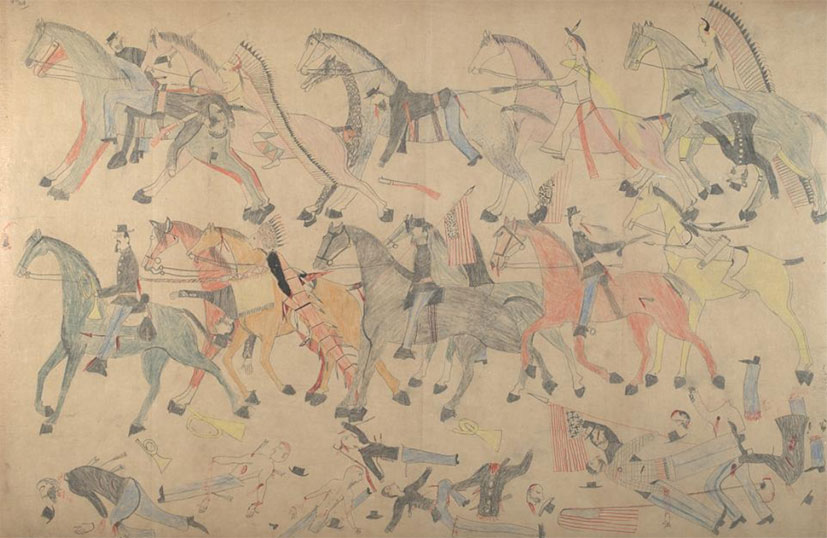
When Murie was a young child growing up on the Rocky Boy’s Indian Reservation snuggled in the picturesque Bear’s Paw Mountains of north-central Montana, he would often draw horses and cattle—two animals that were prominent in the ranch culture of the reservation and surrounding countryside. “We were inspired to create art through viewing animals such as cattle and horses,” says Murie. The horse was especially pronounced in their art. “Drawing a horse was common. We tried to capture the feeling as a people of the horse,” he notes. This natural move toward creating art based on culture heavily influenced by ancestral customs of the Chippewa-Cree tribes has been central to Murie’s teaching style. Murie, who teaches introduction to beading, Native American art history, drawing, painting, and mat-cutting and design, “naturally” emerged as an artist himself. He first began with beadwork because of the influence of his aunts and grandmothers.
As is the case with most tribes, the Chippewa and Cree have no word for art. Murie points out that the elders of his community confirmed this with him: “Art is an everyday happening— it is something we just live with…one of the reasons for this is that our tribe placed ‘art’ on everyday things we used. We dressed them up [tools, clothes, weapons, tipis, musical instruments]. And we especially dressed up ceremony clothes or pipe bags.” From a practical standpoint, it made no sense for nomadic, buffalo-hunting Plains tribes to lug around typical, modern American art such as sculptures or paintings. Instead, usable items were adorned with creative designs. And many of them were stunning and beautiful. Murie says that at Stone Child art is fostered in the natural way—by making it out of traditional possessions such as hand drums, tipis, tanned deer hides, and clothes. Much of the college’s art is associated with painting, drawing, and beadwork. Students have also been quite successful with drum-making. The Rocky Boy’s reservation community has a vibrant drum culture with many well-known groups such as the Southern Cree. “We try to get the community involved in drum making. We have actually had some students teach other students and the community how to make the drums,” he maintains.
The dominant society, however, has also swayed and influenced creativity at SCC. As a boy, Murie read Superman, Spiderman, and Batman comics and developed a more contemporary style involving drawing and painting. Over time, he began to create more of his own art, especially after attending the Institute of American Indian Arts in Santa Fe. Murie states that contemporary art has had a significant influence on students’ conceptual creations. Many students blend popular culture with their tribal world, which is often manifested in a variety of ceremonies such as powwows, round dances, grass dances, and sweat lodge ceremonies.
Murie says that the artists at Stone Child try to emulate “our views [of the world] in our art.” The tribe’s traveling drum groups see other parts of the world and come back with different conceptions of art. “They get to see different designs on the powwow trail,” he observes. These novel patterns and motifs then unfold organically throughout the Rocky Boy’s Indian Reservation and Stone Child College. “Anything we do and learn always looks back to our ancestors. They taught us [how to make art] such as beadwork; this could also be done by our living relatives too, such as aunties and grandmothers. We pass it on.” At the same time, Murie also recognizes the evolving nature of art, emphasizing that “art is always changing—we all want to put our own little mark on it. We seek innovation. We never want to be stagnant.”
Murie maintains that American Indian artists find their own ways with drawing and painting. “We try to figure out what to fit into the world without being tagged as a Native American artist.” He stresses that Native artists want to be known for their originality—just like any artist. And like art everywhere, art at SCC is non-static; it is constantly evolving and combining new ideas with honored traditions. If you glance toward the shining Bear Paw’s Mountains of north central Montana, you might see this grandeur manifest in the classrooms of Stone Child College.
Jerry Worley, Ed.D. is originally from the Fort Peck Indian Reservation—home to the Nakoda and Dakota peoples in Montana—and currently teaches social studies education in the Department of Education Studies at the University of Wisconsin–Eau Claire.




Leave a Reply
You must be logged in to post a comment.